Gate 1
Selection Quality
Does the candidate deserve attention before capital is considered?

A network-aware portfolio intelligence architecture for reading relationships, governing selection quality, studying behavior under stress and refining capital decisions inside one disciplined operating loop.
Quantic Eagle is not built around one model, one signal or one market condition. It is a repeatable ecosystem designed to generate many candidates, reject most of them and promote only the behaviors that remain coherent across validation, stress review and capital use.
An operating architecture designed for repeatability: research discipline, candidate filtering, validation, stress review, risk governance and monitoring inside one controlled decision loop.
The architecture supports disciplined research, model development, historical review and controlled use of capital with monitoring built into the process.
Scalable compute for rapid experimentation and robust iteration, enabling repeatable validation cycles.
A central decision environment that evaluates model behavior, applies internal logic and produces structured materials for monitoring, review and control.
Operational components remain internal, controlled and protected. Any deeper professional material is designed to explain behavior without exposing the system.
A controlled environment where new modeling ideas are challenged, rejected or refined before they can become part of the operating architecture.
A governed set of proprietary decision components designed for diversity, disciplined filtering, and lower single-model dependence.
Independent model families evaluate market structure from different angles to strengthen diversity, reduce dependence on any single model and support more resilient decisions.
A primary decision environment evaluates independent model behavior and produces final decisions under reproducible rules, risk boundaries and monitoring discipline.
A risk discipline that assesses portfolio impact and applies clear boundaries, prioritizing controlled exposure, drawdown awareness and operational readiness.
We do not disclose training code, proprietary feature engineering, or model weights publicly.
Traditional quantitative systems monitor positions. Quantic Eagle monitors the relationships between them.
Cross-asset stress rarely arrives as a headline. It propagates through correlations, sensitivities, and exposure structure before it is visible at the P&L surface. A 100-asset book contains 4,950 unique pairwise relationships, 9,900 directed cross-asset relationships, and 10,000 matrix cells when self-relations are included. Any one of those relationships can flip during a regime shift. The system reads those relationships continuously, not one asset at a time.
The portfolio is treated as a single interacting network, not 100 isolated time series. When two positions that once moved independently start tightening, the system can flag the structural change before anyone declares a correlation regime shift.
The ecosystem can start from a recommended universe of liquid assets, but the architecture is not dependent on a fixed list. If an asset loses liquidity, is delisted, fails or no longer fits the operating perimeter, it can be removed and replaced with a more suitable liquid asset while preserving network-aware governance.
The cross-asset view is updated daily. The system monitors shifts in the relationship structure, not just the price, helping surface stress propagation before the impact is fully visible in the P&L.
For a deeper exploration of the network intelligence thesis, see The Mycelium Effect.
The evidence discipline is organized around three gates before capital is scaled: selection quality, blind review across unseen market periods and behavior under stress. Live coherence is the final evidence surface, not a substitute for it.
Gate 1
Does the candidate deserve attention before capital is considered?
Gate 2
Does behavior remain coherent outside the development window?
Gate 3
Does the system remain governable when pressure changes the environment?
Final Layer
Does live behavior stay aligned with the evidence that justified deployment?
Scaling
Exposure grows only when behavior, risk and evidence remain aligned.
We evaluate decisions on market periods that were not used during development, so the review is not limited to conditions the system has already seen.
We review behavior under adverse conditions and simulated shocks to identify fragility and improve risk boundaries.
Monitoring materials help diagnose risk exposure, behavior changes and operational issues before they become visible only through performance.
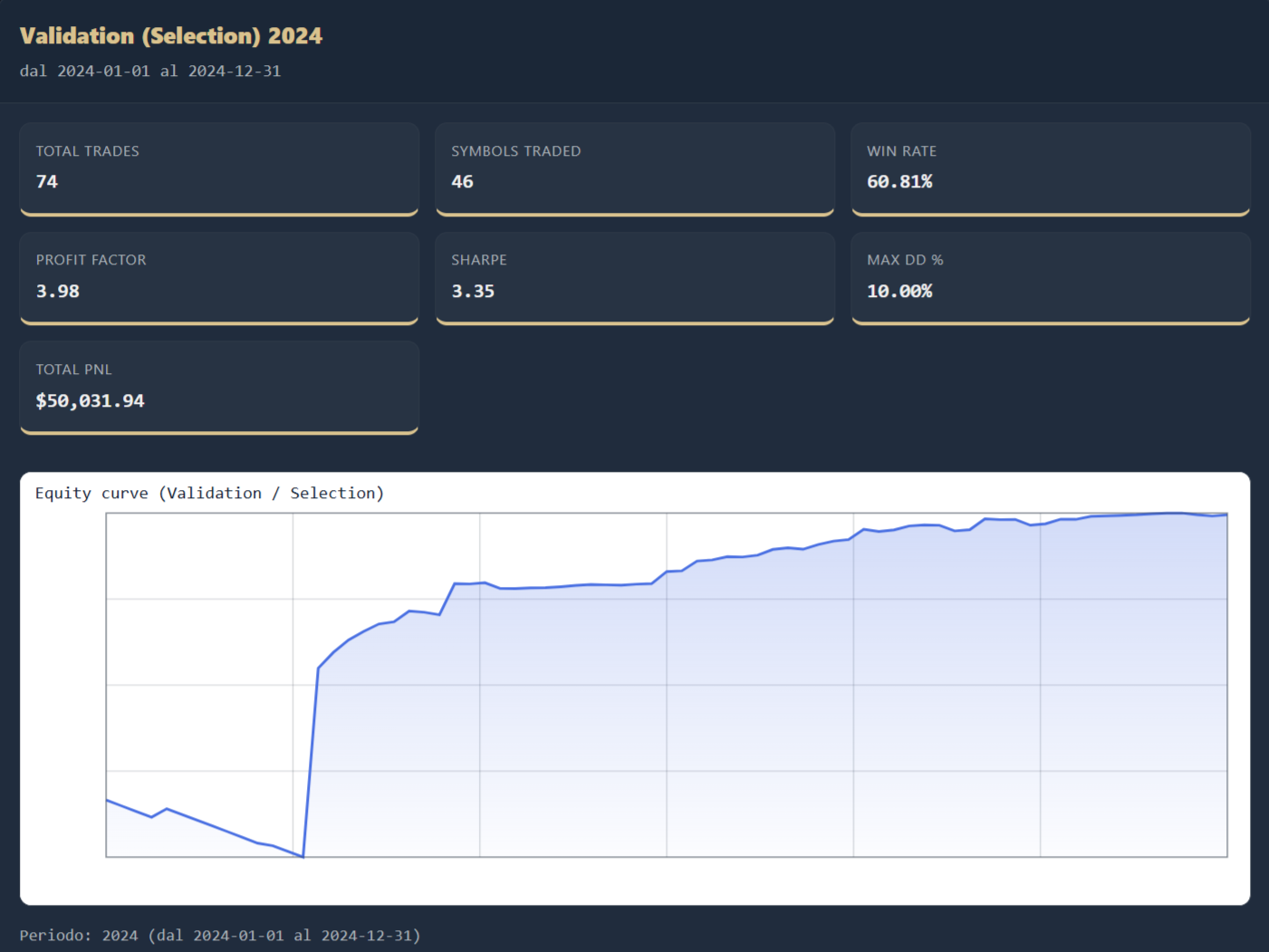
Internal research snapshot: KPI summary and equity curve from the validation stage.
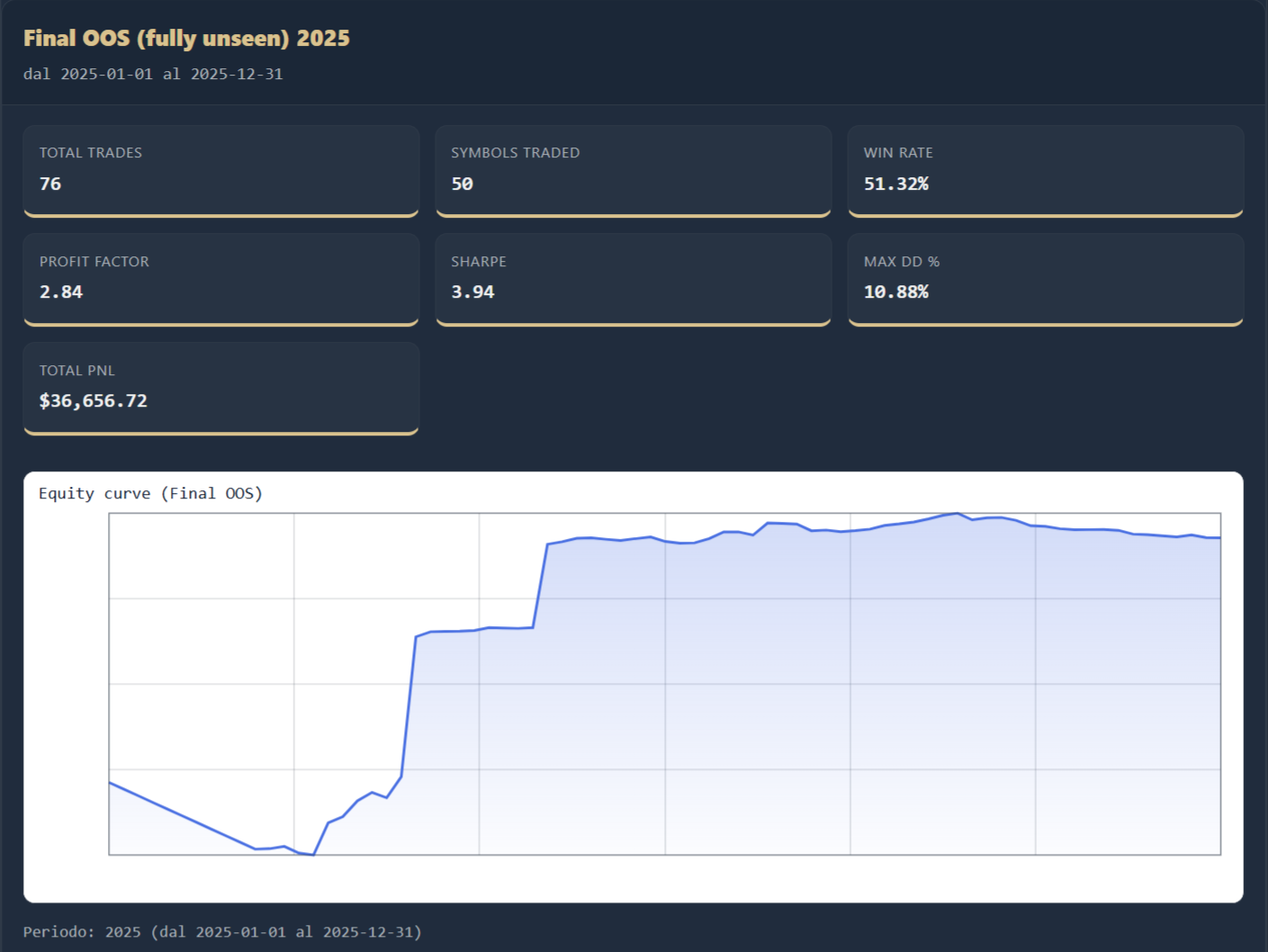
Internal research snapshot: forward review on unseen data under consistent assumptions.
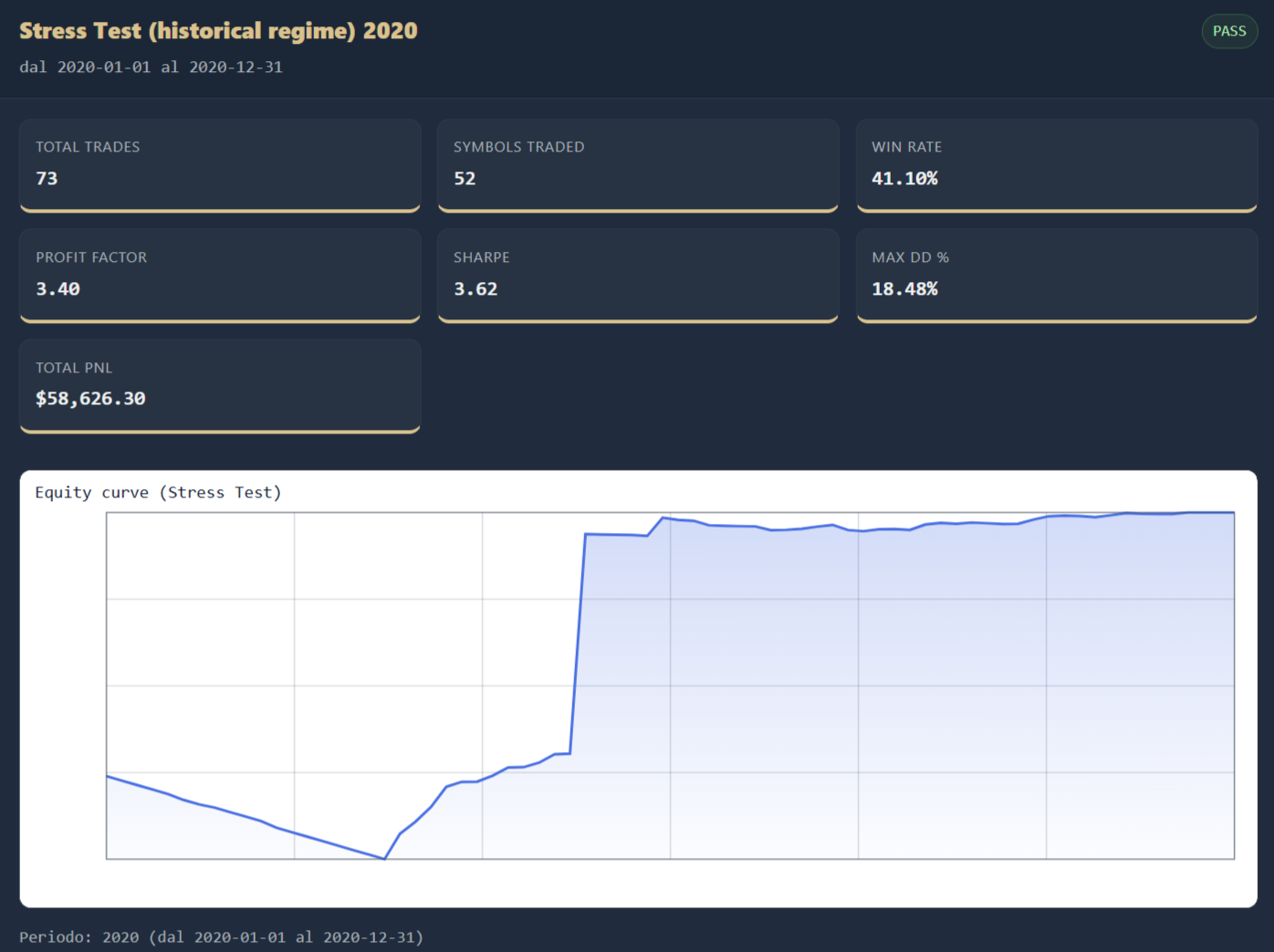
Internal research snapshot: regime-pressure behavior review for risk containment analysis.
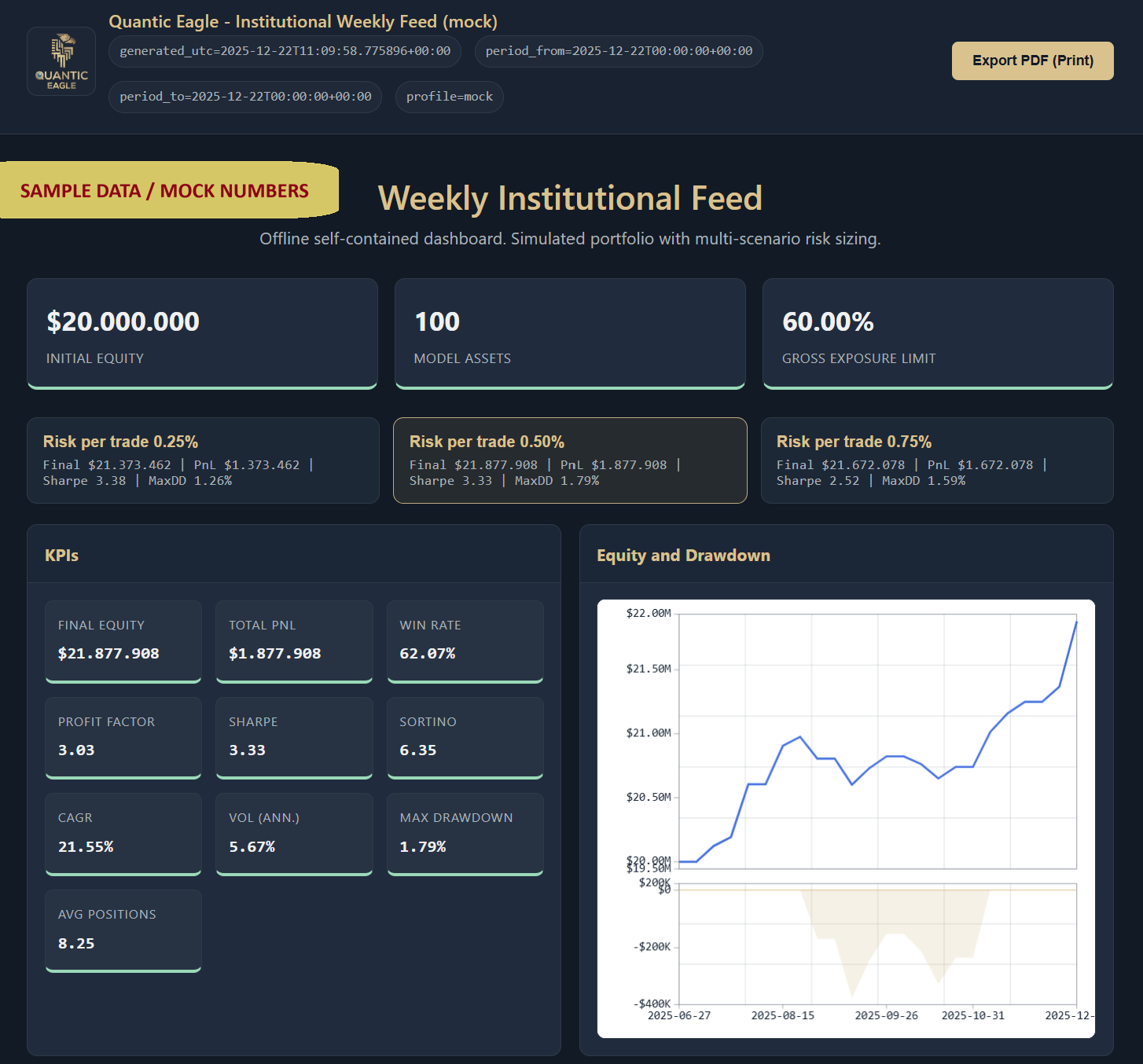
Internal monitoring interface used to study positions, exposure, equity behavior, and drawdown context.
Internal research visuals and a monitoring mock interface for methodology review only. Not indicative of future results.
The current priority is internal capital deployment, system refinement and structured evidence accumulation. Professional conversations remain selective and make sense only when there is a clear institutional, strategic or infrastructure-level reason to engage.
Observable behavior, risk discipline, portfolio-level monitoring, stress response and the coherence between validation work and refinement under capital.
Proprietary training code, feature engineering, model weights, internal decision logic, execution access and system internals are not disclosed through the public site.
A deeper conversation may be relevant when a qualified counterparty sees strategic value in the architecture, the network thesis and the long-term potential of governed portfolio intelligence.
The public site explains the category, the architecture and the evidence discipline behind Quantic Eagle. If a deeper conversation happens, it should be because the counterparty sees strategic value in the operating architecture and understands why portfolio intelligence is becoming an infrastructure-level question.
For professionals evaluating how portfolio intelligence can remain observable, governed and coherent as market regimes change.
For family offices, strategic investors and long-term capital partners interested in infrastructure-level portfolio intelligence.
For acquirers, technology-led financial groups, systematic teams and professional counterparties evaluating the architecture as strategic infrastructure.
Quick clarifications for institutional evaluation and research discussions.
Quantic Eagle is focused on internal capital, controlled system refinement and structured evidence maturation. Any deeper professional conversation remains selective and case by case.
No. Professional review contexts do not provide execution access. Quantic Eagle does not provide third-party portfolio management or retail services.
They are internal research snapshots and/or mock interfaces with sample data, used to illustrate methodology, monitoring discipline and operating visibility. They are not indicative of future results.
A professional conversation makes sense only when there is strategic alignment.
Quantic Eagle is focused on internal capital, controlled system refinement and long-term evidence maturation. External conversations remain selective and case by case.